
 Turning Contracts into Business Intelligence – How Mercatys Makes Contract Management More Transparent
Contracts play a fundamental role in how companies operate. They define prices, discounts, payment terms, deadlines, service levels, termination options, and many other business obligations.
The problem usually isn't that this information doesn't exist.
The problem is that it's locked inside contracts.
For a few-page agreement, this is still manageable. But with dozens or hundreds of contracts, each structured differently and regularly amended, manually tracking this information becomes an increasingly heavy administrative burden.
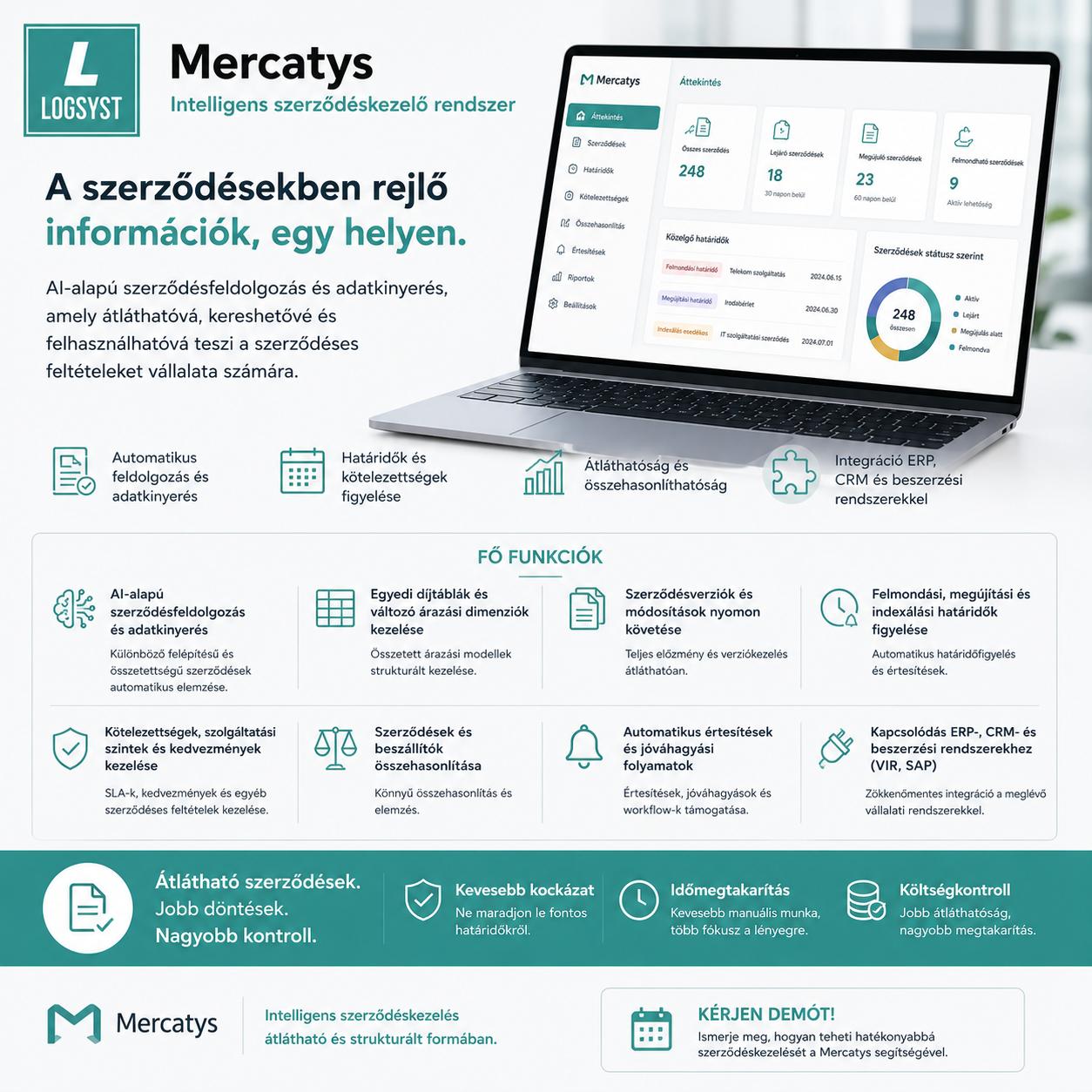
The purpose of Mercatys is to turn the content of contracts into structured, searchable information that can also be used across the company's other processes.
📑 A contract isn't just a document
A supplier or service contract contains a lot of information that can directly affect a business's costs and operations.
This can include, for example:
- 💰 the unit price or service fee,
- 📉 the contracted discount,
- 📅 the contract's expiry date,
- 🔄 the date of automatic renewal,
- 📈 the method of annual indexation,
- ⏰ the termination notice period,
- 🎯 the expected service level,
- 📋 other obligations and terms undertaken.
If this information exists only in PDFs, Word documents, or various folders, the business has to search for and interpret the original contract every single time.
That's time-consuming, and with a larger contract portfolio it can result in a process that's hard to keep track of.
🤖 What does an AI-based contract management system do differently?
Mercatys uses AI-based contract processing and data extraction.
The system can identify defined business information from contracts of varying structure, length, and complexity.
The goal is that, for example, a fee, deadline, or indexation rule found in a 40-page contract doesn't just exist as text, but is also available as structured data.
In simplified terms, the process looks like this:
📄 Contract → 🤖 AI processing → 🔍 Terms recognized → 🗂️ Structured data → 📊 Business use
This fundamentally changes how a business can look at its contract portfolio.
🔍 Faster search within contracts
One common problem with traditional contract management is finding information.
When does a given contract expire?
What discount did we agree on?
What indexation rule applies for next year?
What's the notice period?
Which contract amendment contains the currently valid price?
With structured data extraction, this information no longer exists only in the original document — it can become searchable and comparable data.
🔄 Tracking contract amendments and versions
In practice, many contracts don't consist of a single document.
The original agreement may be followed by an amendment, then a new rate table, an addendum, or another attachment.
With Mercatys, contract versions and amendments can be tracked, making it more transparent which terms apply at any given point in time.
This can be especially important for procurement, finance, and management decisions.
⏰ The deadline you don't want to miss
A missed termination or renewal deadline can have a direct financial consequence.
That's why Mercatys can monitor termination, renewal, and indexation deadlines, and manage automatic notifications.
This means a contract is no longer a document you only look at when you already need it.
The system can flag in advance when a contract-related event requires action.
💰 Handling complex rate tables
Pricing in corporate contracts doesn't always follow a simple "product × unit price" logic.
Price can depend on, for example, quantity, time period, service level, or other variables.
That's why Mercatys is also built to handle custom rate tables and variable pricing dimensions.
This can be especially important for businesses working with a large number of suppliers and complex service or procurement contracts.
⚖️ Comparing contracts and suppliers
Once the terms extracted from contracts are available as structured data, it also becomes possible to compare them.
This means the business can not only store contracts, but also analyze the terms within them.
📑 Supplier A → prices, discounts, terms
📑 Supplier B → prices, discounts, terms
📑 Supplier C → prices, discounts, terms
⬇️
📊 Structured comparison
This can open up new possibilities for supporting procurement decisions, renegotiations, and cost analysis.
🔗 Contract data doesn't have to work in isolation
The value of contract management increases significantly when the data can also be used in other company processes.
Mercatys can also be connected to ERP, CRM, procurement, BI, and SAP systems, so the information extracted from contracts doesn't necessarily stay confined to a standalone system.
Structured contract data can, for example, also form the basis of procurement, finance, reporting, or audit processes.
📊 What does all this mean for a business?
The goal isn't simply to digitize contracts.
A contract stored as a PDF is already digital — but that alone doesn't make the information within it usable in an efficient way.
The next step is structuring the contract's content and putting it to business use.
Less searching. 🔍
Less manual record-keeping. ⌨️
Better deadline tracking. ⏰
More transparent obligations. 📋
More comparable supplier terms. ⚖️
More usable business data. 📊
Mercatys puts this approach at the center of contract management:
A contract shouldn't just be a document we store – it should be structured information we can actually use.